
Juvéderm Deal
Book a Juvéderm appointment by 9/19, get $75 off per syringe.

Kybella for Double Chin: What It Is, How It Works, and Whether It's Right for You
.png)



Kybella is a prescription injectable whose active ingredient is deoxycholic acid, a bile acid your body already produces naturally. According to DermNet NZ, deoxycholic acid is a secondary bile acid produced by intestinal bacteria acting on primary bile acids secreted by the liver. Its everyday job is emulsifying dietary fats in the gut to help your body absorb them.
The version used in Kybella is a purified, synthetic form of that same molecule. The FDA approved Kybella in April 2015 for adults with moderate-to-severe submental fat, making it the first and only FDA-approved injectable for this purpose. The approval followed two randomized clinical trials involving 1,022 adults.
When injected into subcutaneous fat beneath the chin, deoxycholic acid disrupts the fat cell membrane, causing the cell to break down. Research published in a peer-reviewed PMC journal explains that after the cell destruction, macrophages clear away the debris and also stimulate collagen production through fibroblast recruitment, meaning the treatment may have mild skin-tightening effects as well.
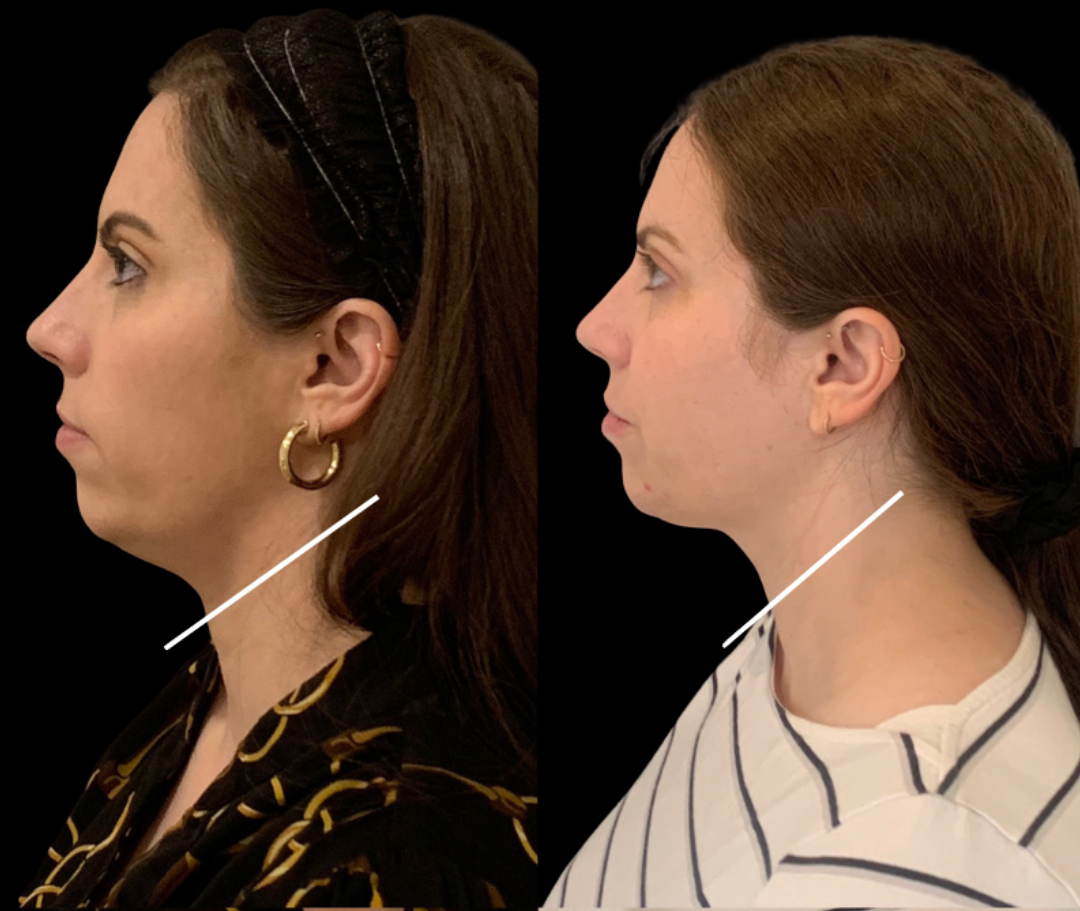
The word "permanent" gets used loosely in aesthetics. With Kybella, it's accurate, and it matters to understand why.
Fat cells don't multiply in adulthood. When you gain weight, existing fat cells get larger. When you lose weight, they shrink. They don't disappear. Kybella is different: it destroys the cells themselves. The FDA's own documentation confirms that when Kybella is properly injected into submental fat, it physically destroys the cell membrane of fat cells.
Once those cells are gone, they can't come back. They also can't expand. That's what makes Kybella's results lasting in a way that diet alone cannot replicate.
One caveat worth knowing: if a patient gains a significant amount of weight after treatment, the remaining fat cells in neighboring areas can still expand. The treated cells won't return, but the overall profile of the chin can shift. Maintaining a stable weight preserves the result.
Most patients need between 2 and 4 treatment sessions, spaced at least one month apart. Some patients with more significant submental fullness may need up to six sessions, which is the FDA-approved maximum. Each appointment typically takes 15 to 30 minutes.
During a session, a provider marks a grid of injection points under the chin and administers multiple small injections of deoxycholic acid into the submental fat. The injection pattern is customized based on the patient's anatomy and the amount of fat present.
Swelling is the most predictable side effect, and it's by design. Research on the mechanism published in PMC shows that the inflammatory response after fat cell destruction is part of how the body clears the treated area: macrophages move in to clean up cell debris and lipids.
Here's what the recovery timeline generally looks like:
According to Allergan, the manufacturer of Kybella, the overall recovery timeline is about one month per session, which is also why providers recommend waiting at least a month between treatments.
One thing worth knowing: first-session swelling tends to be the most pronounced. Clinical observations suggest that subsequent sessions often produce roughly 50 to 70% of the swelling from the first round, making the later treatments easier to manage.
The most common side effects documented in the FDA's clinical trials include swelling, bruising, pain, numbness, redness, and areas of hardness at the injection site. These are generally mild and temporary.
A less common but notable risk: the FDA notes that Kybella can cause nerve injury in the jaw, which may result in temporary uneven smile or facial muscle weakness, and trouble swallowing. Clinical reviews report temporary marginal mandibular nerve paresis in 2 to 4% of patients. This is temporary, not permanent, and it underscores why the treatment should only be administered by trained medical professionals.
The safety and efficacy of Kybella were established in two double-blind, randomized, placebo-controlled trials involving 1,022 adults with moderate or severe submental fat. Data from Medscape shows that at 12 weeks after the final treatment, 13 to 19% of Kybella patients achieved at least a two-grade improvement on both clinician-rated and patient-rated scales, compared to just 3% of placebo recipients. At least 70% of Kybella patients showed at least a one-grade improvement.
Separate clinical studies involving over 1,600 participants demonstrated significant improvements in submental contour and high patient satisfaction. One assessment found a 79% patient satisfaction rate at 12 weeks after the final treatment.
Results develop over time, not overnight. Improvements build across sessions and continue to sharpen for weeks after the last injection as the body finishes clearing the treated fat cells.
Kybella is FDA-approved specifically for adults with moderate to severe submental fat. But not everyone with a double chin is an ideal candidate, and that distinction matters.
Good candidates typically:
Kybella may not be the right fit for patients whose under-chin area is primarily affected by:
Clinical literature is consistent on this point: patient selection is the most important factor in achieving good results. A proper consultation, including a physical assessment of chin anatomy, is what determines whether Kybella is the right tool or whether another approach (such as a neck lift or skin-tightening treatments) would serve the patient better.
The FDA also cautions extra care for patients who have had prior surgical or aesthetic treatments in the submental area, and the treatment is not approved for use outside the submental area.
.png)
Q: Is Kybella FDA-approved?
Yes. Kybella (deoxycholic acid injection) received FDA approval in April 2015 for adults with moderate-to-severe submental fat. It is the only injectable treatment FDA-approved for this specific indication.
Q: Does Kybella permanently remove fat?
Yes. Kybella destroys fat cells permanently. Once the treated cells are gone, they cannot regenerate or return. Maintaining a stable weight helps preserve the result.
Q: How many Kybella sessions will I need?
Most patients need 2 to 4 sessions. Some may need up to 6, which is the FDA-approved maximum. Sessions are spaced at least one month apart to allow for recovery and evaluation.
Q: How long does swelling last after Kybella?
Swelling typically peaks in the first 24 to 48 hours and gradually subsides over 1 to 2 weeks. Some mild swelling or firmness may persist for up to a month. Full results develop over 4 to 6 weeks after each session.
Q: Does Kybella hurt?
Patients typically experience mild stinging or burning during injection. Providers commonly numb the area beforehand. Post-treatment discomfort (tenderness, soreness) is common for a few days and manageable with over-the-counter acetaminophen and ice.
Q: Who is not a good candidate for Kybella?
Kybella may not be appropriate for patients whose under-chin appearance is caused primarily by loose skin rather than fat, submandibular gland issues, or platysmal banding. It is also not for use if there is an active infection at the injection site, and caution is advised for patients with prior submental procedures. A consultation is essential to determine candidacy.
Q: Can Kybella be used on other areas of the body?
No. Kybella is FDA-approved only for the submental area (under the chin). Off-label use elsewhere is not recommended by the FDA.
Q: What is the difference between Kybella and Belkyra?
They are the same medication with different regional names. Kybella is the U.S. brand name; Belkyra is used in Canada and Europe. Both contain identical formulations of deoxycholic acid.
If submental fullness is the one thing that has consistently bothered you, in photos, in the mirror, just in general, Kybella offers something diet and exercise genuinely cannot: the ability to permanently remove the fat cells themselves.
It's not instant. It takes sessions, some downtime, and patience. But the underlying mechanism is sound, the clinical evidence is solid, and for the right candidate, the results are lasting.
At Elevate Medical Center in Kent, WA, our team can assess whether Kybella is the right fit for your anatomy and goals. Every chin is different. A consultation is where that conversation starts.
Book your consultation at Elevate Medical Center and feel free to reach out with any questions.
Schedule a
Consultation
13210 SE 240th St, Suite C1
Kent, WA 98042
(206) 829-0290
Mon - Sat: 9am - 6pm
Sun: Closed
NPI: 1285316562
Join the Club
Join our email list and get access to specials deals exclusive to our subscribers.
13210 SE 240th St, Suite C1
Kent, WA 98042
(206) 829-0290
elevatemedicalcenter@outlook.com
Mon - Sat: 9am - 6pm
Sun: Closed
Join the Club
Join our email list and get access to specials deals exclusive to our subscribers.